Best Way to Attach Plastic Under House Crawl Space
Crawlspaces offer all of the headaches of a basement and none of the benefits. Moisture tin can enter the crawlspace equally either liquid water, unremarkably caused by poor surface drainage around the foundation, or every bit water vapor from the soil. When it isn't actually forming puddles, this moisture can condense on libation surfaces—such as floor joists and subflooring—where it can promote mold growth and rot. Adding vents to introduce fresh air can work when the air is dry and non as well warm or common cold, but information technology often backfires and exacerbates the problem by either calculation moisture from humid air, as is the instance in hot, boiling climates, or cooling the crawlspace air, which promotes condensation on forest framing. Whether or not a crawlspace is vented, the floor and foundation should be isolated from the framing. [For more information on crawlspaces, visit CrawlSpaceRepair.com. Also search past "building component" for "foundation and floors" at the Building America Solution Middle.]
What follows is a step-past-footstep look at how to properly retrofit an existing crawlspace with a continuous vapor barrier sealed at the seams and edges.
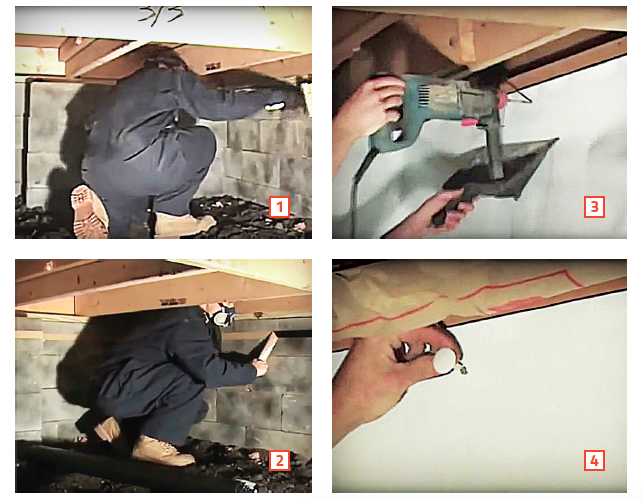
Apply Record to the Foundation
Seal the vapor barrier to the foundation with double-sided Foundation Seal Record (see Source of Supply). Keep the tape near 3 inches downwardly from the height of the wall to exit a termite inspection gap [1] . The tape bonds well to cake and concrete, only only if the wall surface is free of dust, insulation fibers, and other contaminants. To remove any loose particles, employ a soft brush, not a wire castor—particularly on a block wall; a wire brush creates dust that fills the pores in the block and makes it difficult for the tape to adhere. Printing the record into identify along the tiptop of the foundation wall, leaving the paper bankroll in place. When the perimeter is completely taped, peel off but plenty of the newspaper facing to betrayal the tape in the get-go department of wall you program to cover [2] . Don't skin off also much at one time; on long walls, yous tin can peel off the paper as yous get. Press the vapor barrier textile—we're using DiamondBack hither—into the sealing tape, beingness careful to keep it level and flat. This work tin can be done solo, but it'southward much easier with two people. Foundation Seal Record will temporarily hold the plastic sheeting in place until y'all install mechanical fasteners.
Fasten the Vapor Barrier
With the first section of vapor barrier properly positioned and stuck to the tape, drill holes through the plastic into the block about two feet on center [3] . Drilling through the tape will preclude the plastic from peeling off when y'all remove the drill. At inside corners, drill a pigsty on both sides to relieve tension at the corner and assistance maintain the tape seal. It'southward a good idea to use a dust pan to take hold of larger pieces of concrete. Otherwise information technology creates a mess on the sheeting that's annoying to work in and may also cause punctures. Use plastic Foundation Pins to carry the weight of the vapor barrier. These pins are held in identify by compression and must be lightly hammered into the pre-drilled holes [4] . Properly installed, they will take the load off the tape and will permanently hold the plastic in place.
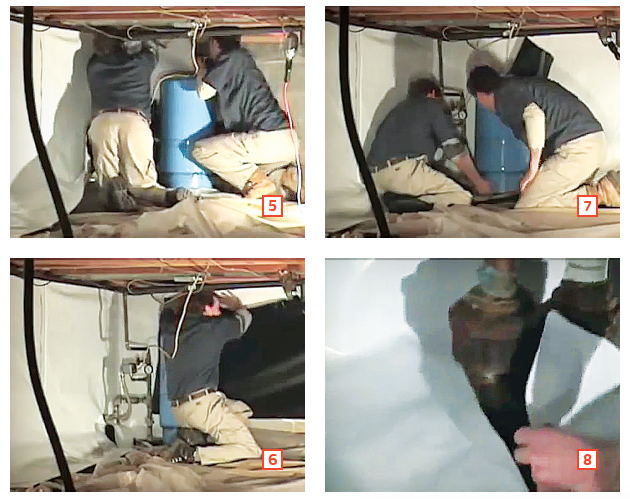
Working Around Obstacles
Water heaters, pressure tanks, and other equipment oft located in the crawlspace nowadays an impediment to maintaining a continuous vapor bulwark. In some cases, they may have to exist temporarily disconnected, just typically two people tin piece of work together to elevator them enough to allow the plastic sheeting to be slipped underneath. In the project shown here, 3 pieces of DiamondBack sheeting were used to handle both the corner and the area under the pressure tank. The wall piece on 1 side of the corner folds onto the flooring and effectually the corner about a foot [v] . The wall piece on the other side of the corner is longer so that it tin run under and a chip beyond the bladder tank. The slice on the flooring overlaps the wall pieces, and the seams are taped. The trick to fastening the plastic to the seal tape while working in the tight space backside the pressure tank is to fold the material in half (bottom folded up to the elevation) [6] . When information technology'due south fourth dimension to unfold the plastic and slide it nether the tank, it takes some maneuvering to get the tank to the right spot because the vapor barrier cloth tends to bunch up behind it [7] . Make sure you have enough people on mitt and accept the fourth dimension to go information technology exactly where it needs to exist. If you have to come up dorsum later to reposition it, you may create wrinkles or cause fasteners to pop.
Dealing With Penetrations
Inevitably, you will encounter a sewer or water line coming up out of the floor. In the case of a sewer line like the 1 shown here, trim the bottom of the wall plastic in a circular shape halfway around the sewer line [8] . Lay the remaining flap against the sewer line and trim it to fit every bit close to the pipage every bit you can. Use Waterproof Seam Tape to seal the seam and to seal the edges of the plastic to the sewer line itself.
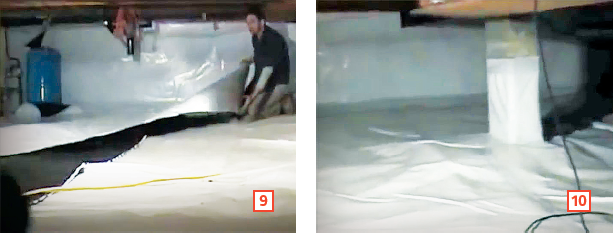
Embrace the Flooring
With all of the wall material sealed and fastened in place, information technology's time to cover the remainder of the floor. Showtime, take off your piece of work boots so every bit not to damage the vapor bulwark. Then make sure that any cables or phone lines are on acme of the vapor barrier [9] . This minimizes penetrations, makes these lines piece of cake to access after for service, and keeps them warm and dry out on summit of the vapor barrier rather than cold and wet underneath it. Wrap support posts about 2 feet up and overlap the floor layer on the base of the support plastic [10] . Afterward checking that all seams in the vapor barrier are sealed, call it a day.
Source of Supply
The materials used to encapsulate this crawlspace are trademarked and supplied by CrawlSpaceRepair.com. They include: Foundation Seal Tape, a i ½-inch-broad reinforced tape that comes in 108-foot-long rolls; DiamondBack, a 12-mil polyethylene liner (several other liners between 6- and 20-mils are also available); Foundation Pins, the heavy-gauge, white plastic pins used to back up the liner; and Waterproof Seam Tape, a white, 4-inch-broad tape that comes in 187-footlong rolls.
Find more Building Science hither
Source: https://www.proremodeler.com/how-install-vapor-barrier-sealed-crawlspace
0 Response to "Best Way to Attach Plastic Under House Crawl Space"
Post a Comment